For more than twenty years, I have worked in educational robotics as a teacher, curriculum developer, instructional designer, and creator of robotics models.
During this time, I have developed individual lessons, long-term programs, extracurricular courses, and a complete school robotics curriculum. In Ukraine, I implemented robotics as a regular school subject taught systematically, just like mathematics, science, or computer science.
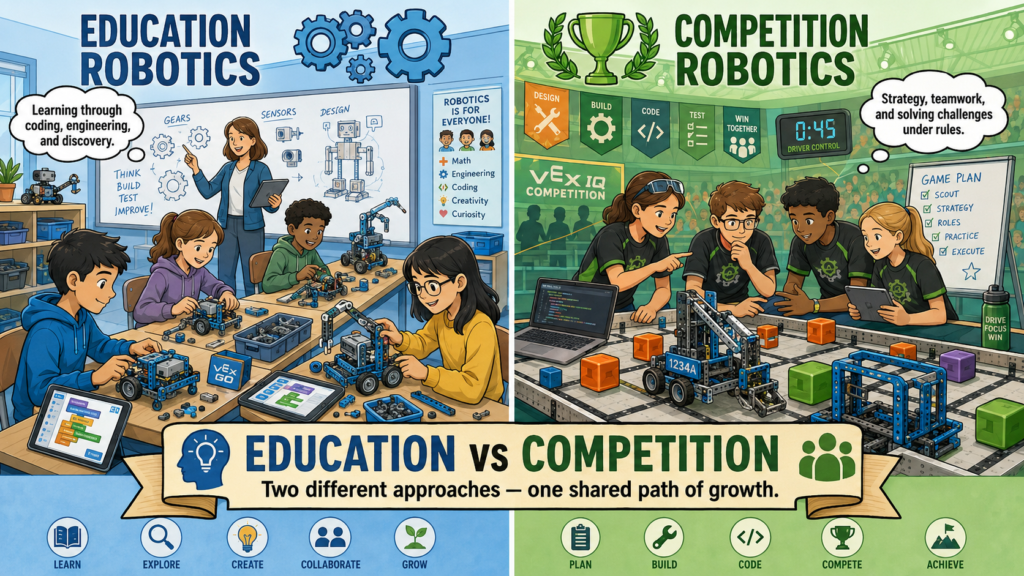
I have worked with different age groups, educational platforms, and instructional formats. I have observed how children develop both in regular classroom settings and during competition preparation. This experience has convinced me that educational robotics and competition robotics should neither be confused nor placed in opposition to each other.
They often use similar equipment, including construction systems, motors, sensors, and programming tools. However, they have different goals, different learning structures, and require different teaching approaches.
I do not believe that one direction is better than the other. In fact, they are deeply connected. However, to create a strong robotics program, educators must clearly understand where a broad educational course ends and focused competition preparation begins.
Educational Robotics
Educational Robotics: Developing the Child, Not Preparing for a Tournament
The primary goal of educational robotics is not to win a competition or build one highly efficient robot.
Its main purpose is to support the overall development of the child through modern technology.
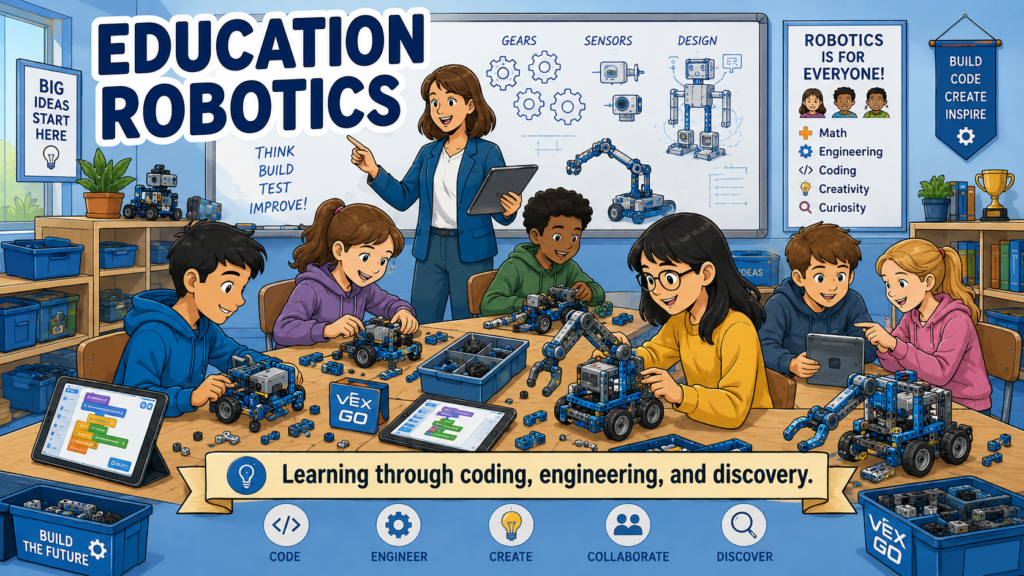
During robotics lessons, students gradually explore engineering and mechanics, computational thinking, programming, motors and sensors, mathematics, science concepts, data analysis, design, and testing.
They learn not only to follow instructions, but also to develop their own solutions, identify and correct mistakes, collaborate with others, explain their ideas, and present their results.
Platforms such as VEX GO and VEX IQ allow teachers to move far beyond building simple vehicles that drive forward or perform basic actions on a field. Students can create robotic arms, manipulators, transportation models, mechanisms with different types of gear systems, and devices for exploring scientific and engineering concepts.
One of the greatest strengths of educational robotics is the variety of topics and models.
A child does not spend the entire school year working with only one robot. Instead, students regularly encounter a new challenge, a new construction, a new mechanism, or a new problem to solve.
One lesson may focus on gears. The next may explore a distance sensor. Later, students may study speed, force, turning angles, coordinates, conditional statements, or loops. They then apply this knowledge in a practical project.
In this way, robotics becomes more than a technical activity. It becomes an educational environment that connects engineering, programming, mathematics, science, design, and creative thinking.
Educational Robotics Should Be Accessible to Many Students
Another important feature of educational robotics is its potential for broad participation.
Many more students can take part in an educational robotics program than in a competition team.
Educational robotics can be organized as an after-school club, an elective, a short-term course, a summer program, a STEM project, or a regular school subject.
In Ukraine, I implemented a complete school robotics curriculum that was taught regularly, in the same way as mathematics, science, or computer science.
In my opinion, this model is extremely important. Robotics should not remain an activity available only to a small number of children whose parents can bring them to a private club. It can become part of modern school education and be accessible to a much wider group of students.
However, broad participation should not come at the expense of quality.
If a class includes 28 to 30 students, it is extremely difficult to provide a meaningful hands-on robotics lesson to the entire group at the same time. The teacher must simultaneously manage construction, programming, equipment distribution, device connections, safety, and the work of every team.
For this reason, a large class should ideally be divided into at least two groups.
When a teacher works with 14 or 15 students, it becomes much easier to support each child, help with construction, explain programming concepts, and observe who is actively involved and who is only watching.
Equipment is another important consideration. Robotics is a hands-on subject, so schools need a sufficient number of kits, computers or tablets, charged batteries, spare parts, and space for testing.
When there is not enough equipment, some students inevitably become passive. Limited access to robotics kits and technical resources is often one of the main barriers to introducing robotics as a regular school subject.
Competition Elements Within Educational Robotics
Educational robotics does not exclude competition.
On the contrary, short competitive challenges can be highly effective teaching tools. In my programs, approximately every fourth lesson may include some type of competition element.
Examples may include robot sumo, tug-of-war, speed races, maze navigation, object transportation, autonomous parking, obstacle courses, or completing a mission within a limited time.
These activities bring energy and excitement to the lesson. They also allow students to apply what they have learned and motivate them to improve their designs and programs.
However, the result of a classroom competition should not become the main measure of a child’s success.
Winning is only one possible outcome. It is much more important to ask whether the student understood how the mechanism worked, identified a problem, improved the program, or learned to explain an engineering decision.
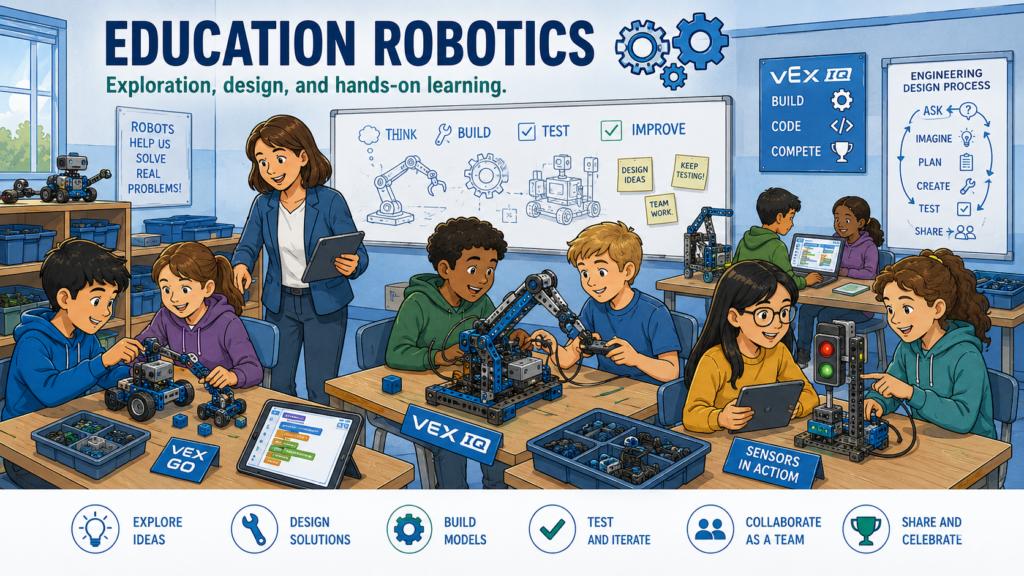
In this context, the VEX GO Competition Field can be an especially useful teaching tool.
Despite the word “competition” in its name, the field can be used for much more than a full tournament. It can also serve as a flexible learning environment during regular lessons.
Teachers do not need to begin by asking students to complete every official mission or use only the standard competition robot.
Instead, students can be given a short task such as:
- delivering one object;
- moving a specific field element;
- opening a mechanism;
- lifting an object;
- driving to a designated zone;
- completing one autonomous mission;
- designing a custom robot for one part of the field.
Students can use different robot designs rather than relying on a single standard model. This transforms the competition field into a versatile environment for short engineering and programming challenges.
Students gradually learn to analyze a mission, plan a sequence of actions, test a mechanism, identify weaknesses, and improve a program. At the same time, the lesson remains varied and does not become months of preparation for only one event.
What Is Competition Robotics?
Competition robotics, sometimes called sports robotics or Olympiad robotics, follows a different structure.
Its main goal is to prepare a team for a specific set of rules, a particular field, and a defined group of tasks.
At the beginning, students may use a basic robot model to learn forward and backward movement, accurate turning, drivetrain operation, motor control, sensor use, basic algorithms, and autonomous programming.
They also begin to explore mechanism control, team strategy, and coordinated problem-solving.
After that, the learning process gradually becomes focused on solving specific problems on the competition field.
Students analyze the rules, identify scoring opportunities, select priority missions, design mechanisms, test them, modify the robot, and repeat the same actions many times.
Unlike an educational course, where each lesson may introduce a new topic or model, competition robotics often involves developing one robot over a long period of time.
Students may adjust the position of a motor, redesign a gripper, change a gear ratio, reposition a sensor, or modify only a few programming commands in order to save a fraction of a second or improve consistency.
This is no longer a broad exploration of many robotics topics. It is a deep and focused effort to solve one complex project.
Competition Robotics Requires Patience
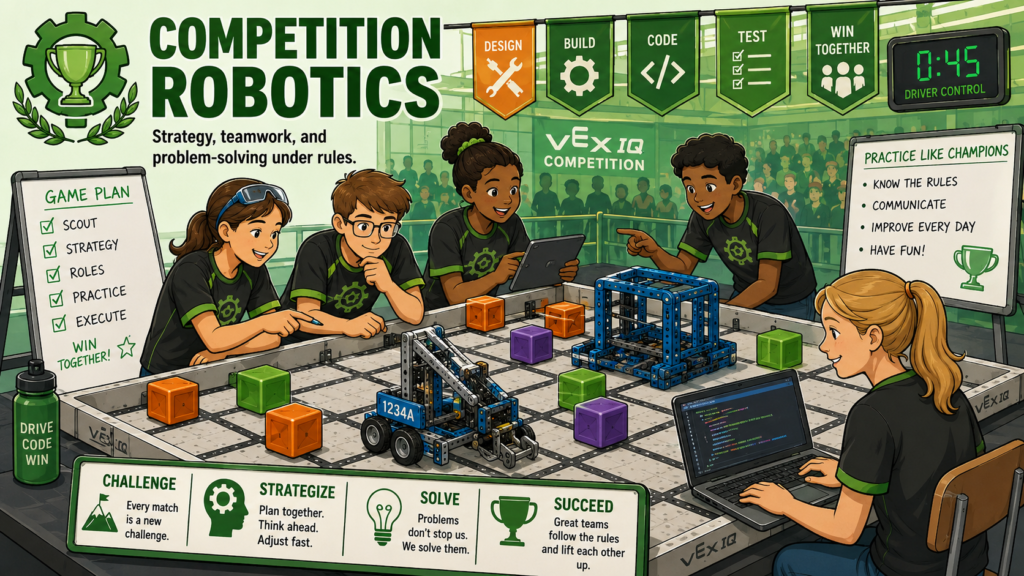
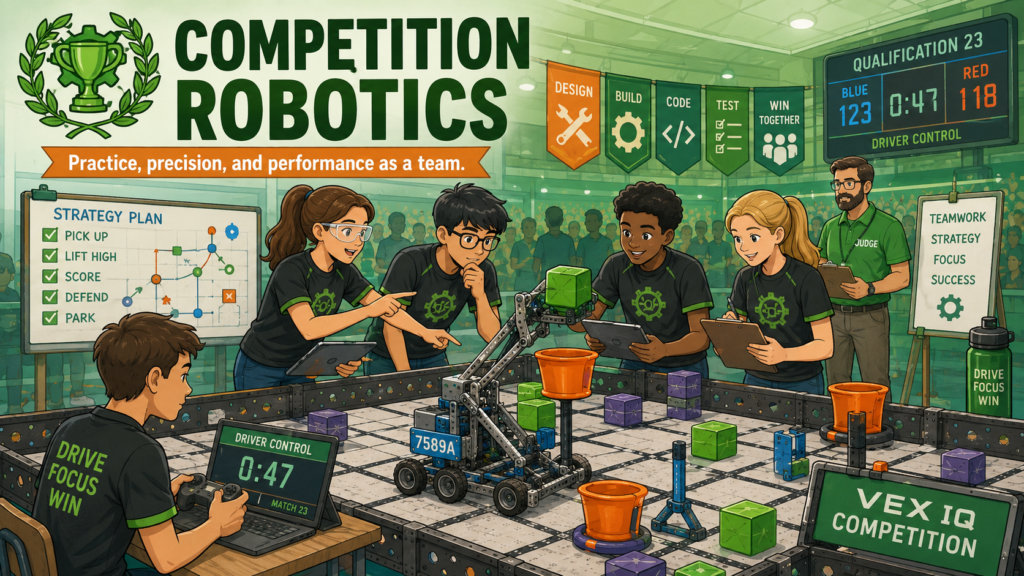
From the outside, robotics competitions appear highly dynamic. There are teams, colorful fields, timers, judges, excitement, victories, and awards.
However, preparation is often extremely repetitive.
One robot. One field. The same game objects. The same route. Dozens or even hundreds of repetitions.
A robot may complete a task successfully nine times and fail on the tenth attempt. The team must determine the cause, make changes, and begin testing again.
For this reason, maintaining the motivation of a competition team can sometimes be more difficult than keeping students engaged in a regular educational course.
Not every child who enjoys building new models is ready to spend months improving the same mechanism. At the same time, a student who may not always stand out during regular lessons can become exceptionally strong in testing, strategy, or autonomous programming.
Participation in a competition team requires more than technical ability. It also requires discipline, responsibility, patience, resilience, and a willingness to complete repetitive work.
Remote Control or Programming?
I would also like to clearly state an important part of my teaching philosophy.
I do not support a model of children’s competition robotics that is reduced almost entirely to driving a machine with a remote controller.
Driver skills certainly matter. Students should understand the robot’s speed, inertia, maneuverability, and mechanical capabilities.
However, remote control should not replace programming.
A robot is not simply a remote-controlled vehicle. The concept of a robot includes a processor, sensors, and a program that allows the machine to perform actions autonomously.
Therefore, even if a competition format includes driver-controlled periods, students should still create and test autonomous algorithms during their preparation.
These can be short tasks such as:
- driving a specific distance;
- turning to an exact angle;
- stopping before an obstacle;
- detecting a line;
- lifting and moving an object;
- completing a short sequence of actions;
- responding to sensor data;
- performing one field mission autonomously.
Programming requires students to analyze a task, divide it into steps, predict the robot’s behavior, and identify the causes of errors.
Remote control develops reaction time and coordination. Autonomous programming develops computational, engineering, and systems thinking.
For this reason, in my view, meaningful competition robotics should always include a strong programming component.
Why Competition Robotics Rarely Works as a Regular Class
An educational robotics course can be included in the school timetable for an entire class or grade level. Competition preparation is more difficult to organize in this way.
A competition team is often formed from students of a similar age who may come from different classes. They are brought together not because they belong to the same homeroom, but because of their level of preparation, interest, motivation, and willingness to work on one project over an extended period.
For this reason, competition robotics is usually organized as an after-school club, a school team, a specialized program, additional training sessions, or a separate tournament preparation course.
The number of participants is another important limitation.
Imagine a school with 500 students. Even if only 10 percent of them are interested in educational robotics, that already represents 50 students. With sufficient resources, the number could be even higher.
However, one competition team cannot include 50 students.
Depending on the rules, age group, and format, approximately two to eight students may work on one robot. Even within that group, roles must be assigned carefully.
One student may focus on construction. Another may work on programming. Others may be responsible for testing, documentation, strategy, or driving.
If too many students are assigned to one robot, some team members will inevitably become passive. Two students may do most of the work while the others only observe.
For this reason, competition robotics cannot be as broadly accessible as educational robotics.
The Example of VEX IQ
The VEX IQ platform clearly demonstrates the connection between educational and competition robotics.
It can be used in a regular educational course to study movement, rotation, sensors, mechanical systems, manipulators, loops, conditional statements, and the engineering design process.
After students develop these foundational skills, they can move into VEX IQ competition preparation.
At this stage, the equipment may remain the same, but the purpose of the work changes.
During an educational lesson, the teacher might say:
“Today we are learning how the distance sensor works.”
During competition preparation, the question becomes:
“How can we use the distance sensor to make the robot stop consistently in front of an object on the field?”
In the first case, the focus is the learning objective. In the second, the focus is a specific result that requires students to apply previously learned knowledge.
This is why a strong foundational course makes the transition to competition robotics much easier. Students already understand basic mechanisms, motors, sensors, and programming, so they can focus more effectively on strategy, reliability, and robot improvement.
Learning First, Team Selection Later
In my opinion, one of the most effective ways to organize robotics in a school or learning center is to begin with a broad educational robotics course and then invite some students to join a competition team.
The first year of instruction reveals much more than a one-time test or short selection process.
A teacher can observe a student’s technical thinking, interest in programming, teamwork skills, patience during testing, response to failure, attention to detail, responsibility, and independence.
At the same time, students have an opportunity to discover what they enjoy most.
Some are excited by building new models. Some prefer programming. Some enjoy fast-paced competitions. Others are most engaged when they can test the same mechanism repeatedly until it works reliably.
Only after this experience does team selection become informed and educationally meaningful.
It is also important to understand that selecting a team is not simply about choosing the strongest students.
A successful team needs students with complementary strengths.
It needs not only builders and programmers, but also careful testers, strategic thinkers, organizers, and students who can support their teammates and take responsibility for a shared result.
Competitions Develop More Than Future Winners
Sports coaches often say that they are not simply preparing athletes for competitions. They are preparing children for life. A person must come first, and only then the athlete.
In my opinion, the same principle fully applies to competition robotics.
Competitions should not be only about trophies, medals, rankings, and victories.
A trophy may remain on a shelf. A season will end. The rules will change. A few years later, the child may no longer participate in robotics competitions at all.
But the person will remain.
What may remain with that child are character, habits, attitudes toward work, relationships with teammates, respect for opponents, and the ability to respond to mistakes.
High-quality competition robotics can teach a child not to give up after an unsuccessful run, to analyze mistakes calmly, to take responsibility for one part of the team’s work, and to respect the contributions of others.
It can teach students how to win with humility and lose with dignity, follow the rules even when it may be possible to avoid them, support the team during difficult moments, and work toward a long-term goal.
Students should also understand that a strong opponent is not an enemy. A strong opponent is an opportunity to discover another approach, identify weaknesses, and learn something new.
This is why the role of a coach or teacher goes far beyond creating an effective robot. The adult also shapes the culture of the team.
Through personal example, the teacher demonstrates how to respond to victory, defeat, judges, opponents, and other children.
If a coach designs the robot, writes the program, provides every solution, or teaches students how to work around the rules in order to win, the children are still learning a lesson. However, it is no longer a lesson in engineering, responsibility, or honest work.
A team may win a trophy and still lose something far more important.
For this reason, the success of a competition robotics program should not be measured only by tournament rankings. It is equally important to ask what kind of person the child is becoming during the process.
Two Directions, One Educational System
Educational robotics and competition robotics should not be placed in opposition to each other.
Educational robotics creates the foundation. It introduces large numbers of students to engineering, programming, mathematics, science, and modern technology.
Competition robotics allows some students to deepen this knowledge, work on a complex long-term project, operate within constraints, and take responsibility for a shared result.
Competition elements can and should be included in regular lessons. At the same time, competition preparation must remain an educational and developmental process rather than becoming only a race for trophies.
Problems begin when winning becomes more important than the child’s development.
If adults build the robot, write the program, and leave students only to drive the finished machine, the team may achieve a strong result. However, the educational value of that result will be minimal.
It is equally harmful when children are taught to blame one another, disrespect opponents, make excuses, or treat every loss as a disaster.
Competitions end. Trophies gradually lose their importance. But the person remains.
Resilience, responsibility, honesty, respect for others, teamwork, and the habit of continuing after failure can remain with a child for life.
These qualities are the most valuable outcomes of competition robotics.
For this reason, we should first help children become strong, responsible, and thoughtful people—and only then successful competitors.
The main measure of a high-quality robotics program is not the number of medals or the complexity of the robot.
The most important question is:
What did the child understand, create, and learn to do independently—and what kind of person did the child become during the process?
This is why educational and competition robotics should develop together.
The first opens the world of technology to many children. The second gives highly motivated students an opportunity to go further, challenge themselves, overcome difficulties, and work toward a team goal.
VEX GO and VEX IQ can become an effective bridge between these two directions—from a child’s first simple model in the classroom to an autonomous robot completing a complex mission on a competition field.
However, the most important result of this journey should never be the robot, the medal, or the trophy.
It should be the development of the child.
For more information about educational robotics, please feel free to contact me.
If you need support, professional training, or consultation, please email me at vasyliuk.anatolii@gmail.com.
Author: Anatolii Vasyliuk
Copying, reproducing, or using these materials without the author’s prior written permission is strictly prohibited.
Images used in this article were generated using AI.